
Musa Guide Catalog
1. Summary
What it is
Musa is the only AI audio guide with spatial awareness deployed in permanent exhibitions worldwide. With the Musa platform, museums build state-of-the-art guides, adapt to visitor curiosity, and go live instantly with museum-controlled content.
Who it is for
World-class storytellers in museums, galleries, and cultural venues of any size that want AI-powered visitor experiences.
Top outcomes
- Deliver the best possible non-human guided experience that responds to each visitor in context of where they are.
- Generate revenue with simple, flexible options.
- Understand visitors with clear analytics that inform programming and operations.
Additional benefit
- Lower hardware spending by using visitors' own devices with no downloads.
Proof points
- Live with Museo Miraflores, an award winning museum about the ancient Maya city of Kaminaljuyu.
2. Why Museums Use It
Problem
Legacy guides are slow and costly to change. Even small edits mean scripts, studios, device rebuilds, and vendor coordination. BYOD apps add delays, limited pricing control, and app download drop-off. Visitors often lack context or want to go deeper but cannot ask in the moment.
What changes with Musa
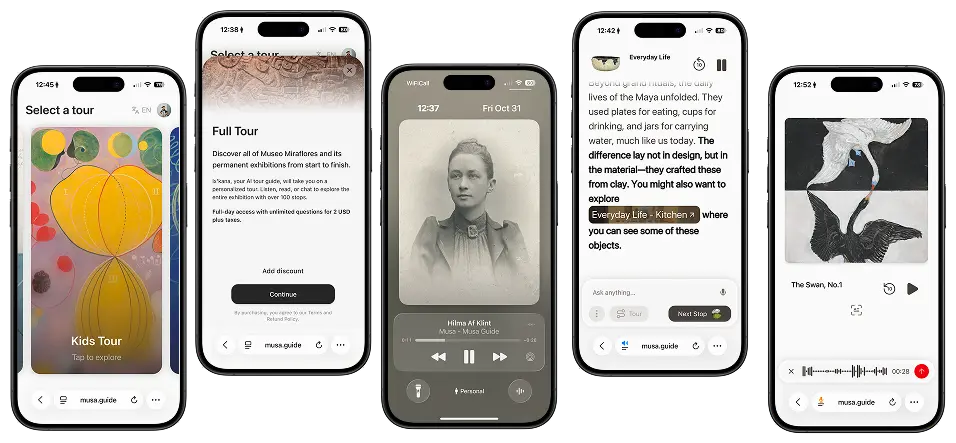
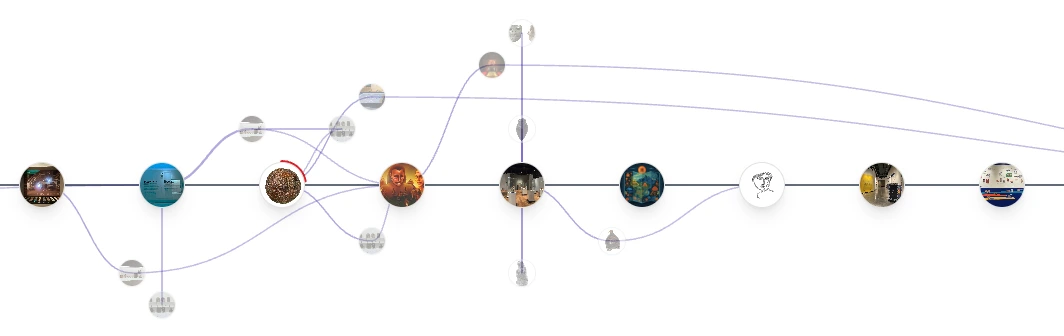
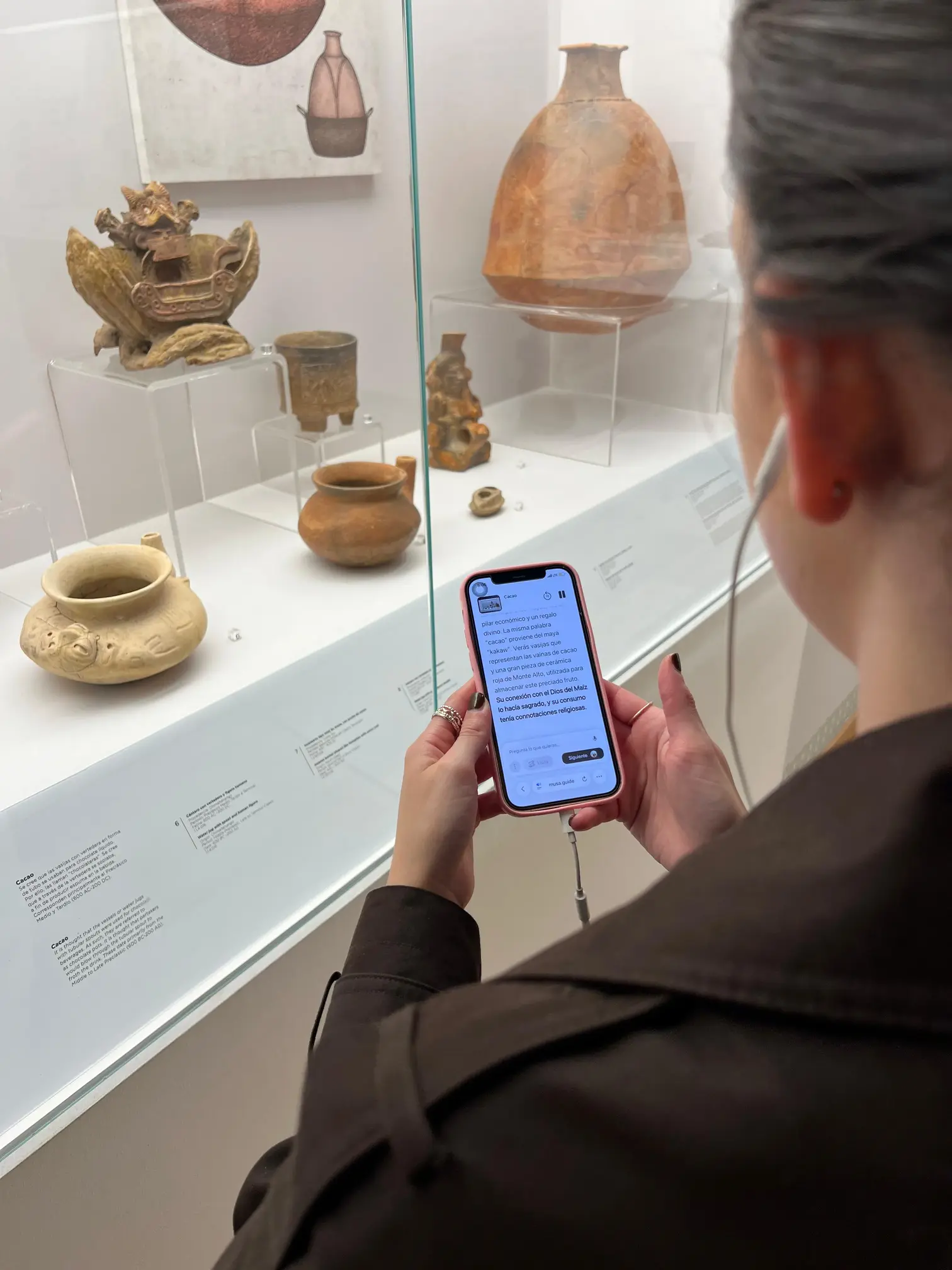
Visitors ask freely and get answers that know where they are—pointing them to details on the object in front of them or guiding them to the next relevant space. Answers are concise, in their language, and they can return to the curated path at any time. The guided path takes away cognitive load—no more wondering which stop to dial next or whether you should skip one. Visitors follow a clear journey and can diverge whenever curiosity strikes, then return seamlessly. Curators own the workflow. Edits publish fast so content keeps pace with labels and exhibitions. Furthermore, spatial awareness works without hardware, allowing you to get started instantly.
At Miraflores, spatial awareness emerged in practical ways visitors hadn't experienced before. At certain stops, Musa prompts visitors to peek out nearby windows and see what looks like an innocent grassy hill covering Mount B-V-III—an ancient Mayan structure hiding in plain sight, preserved under grass to protect it from weather and harsh conditions. A visitor noticed this connection organically and asked about it, leading the museum to incorporate the moment into the permanent tour. Ask Musa for directions to the permanent exhibition and it routes you via the escalators from the second to third floor, explaining the architectural decisions and meaning of the stunning celestial ceiling visible on the way up.
3. Visitor Journey
From QR to first answer
- Scan QR code to open the museum's tour page.
- Choose a tour. There can be one or many, up to the museum.
- Follow the curated path. Ask by speaking or typing at any time, then listen or read.
- Branch into stops that interest you, or continue the path that the museum designed. Musa knows where you are and adapts wayfinding to match.
4. What Visitors Say
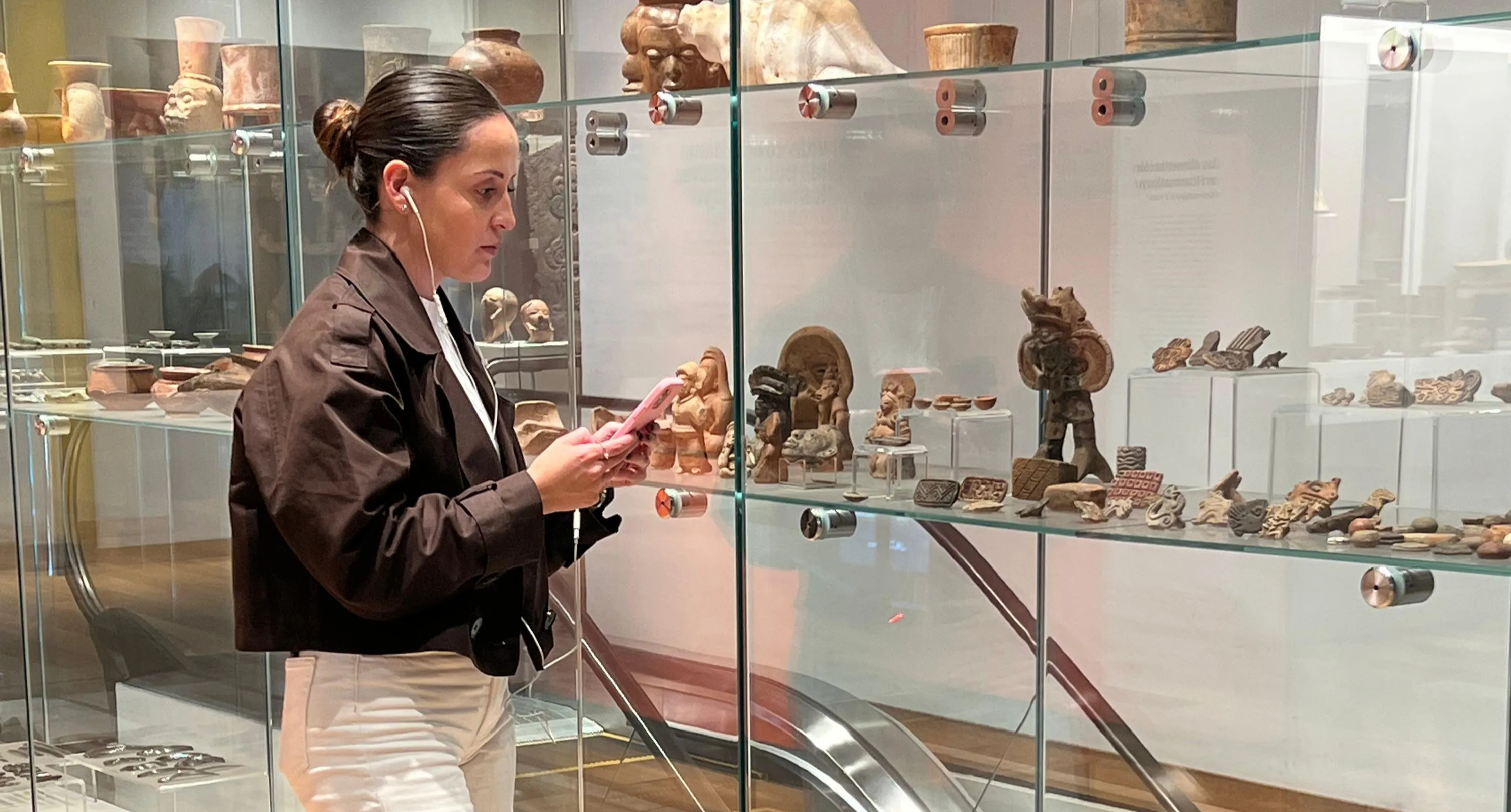
"I was in Mexico recently and when I saw one of the pieces at Miraflores, it reminded me of the Aztec drawing style. I asked Musa about the connection and my intuition was right—there was influence on this piece from central Mexican traditions. It's so cool to be able to connect the dots and bring things from your own life into the exhibition."
"What I really liked is not just the knowledge about the exhibits and items, but the ability to know things about events and other parts of the museum. I was going up to the third floor and saw a poster about the temporary exhibition and Musa was able to tell me all about it. Given that they change frequently, I was surprised this was possible."
"With traditional audio guides or signage I often feel like a bit of an imposter. There's just a lot of background info missing. With Musa I was able to ask anything and even questions I wouldn't want to ask a tour guide in a group setting. It's a lot less intimidating and made it easier to connect the dots"
"It made navigating the museum very easy. I loved taking up the escalators while it showed me interesting details along the way."
"It's the closest I have experienced to a real tour guide. Very impressive. Will be hard for me to go back to traditional audio guides."
5. Features at a Glance
Context aware wayfinding and spatial awareness
Musa knows where visitors are and adapts directions, suggestions, and answers to their exact location. This is not available in other AI audio guides.
Guided path plus free exploration
Follow a curated route, branch to what interests you, then return smoothly.
Ask anything with grounded answers
Responses come from a museum maintained knowledge base with clear labels for supplemental context.
Multilingual, natural voices
Authentic voices with accents and emotion. Visitors can read or listen.
Multimedia
Add images, video, and audio to enrich exhibits beyond what is physically present.
Update anytime
Publish edits in seconds so visitors always see the latest content.
Analytics that inform decisions
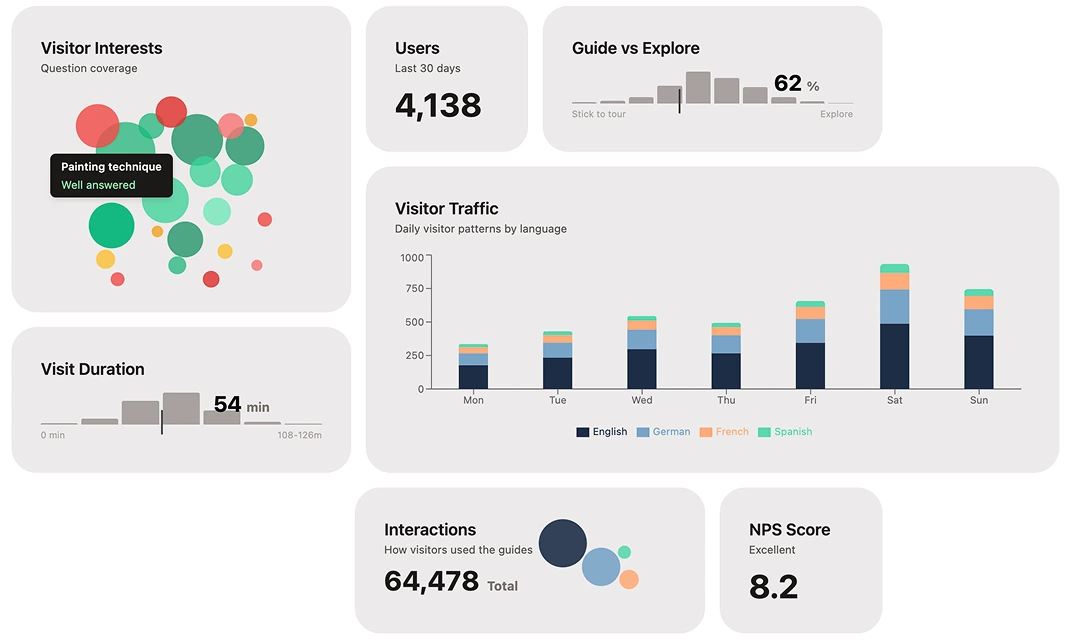
Dashboards show top questions, dwell, language mix, completion patterns, and revenue where enabled.
Payments
Integrate with global payments out of the box. Start on our system and switch to your own when ready.
6. Persona Gallery
Personas deliver your content in your curatorial voice. You choose delivery style, pronunciation, dialects, and even language-specific characteristics. This allows you to build any experience you envision. At Museo Miraflores, the team created Ix'kana, a fictional character that lives and breathes ancient Mayan spirit with her own background, making the experience deeply personal and engaging for visitors.

Hilma af Klint
The artist herself guides visitors through her exhibition. Speaking English with a slight Swedish accent, she keeps sentences short and loves to put visitors in charge of what to focus on along the tour. Born in late 19th century Sweden, she shares her pioneering abstract works with warmth and directness.

Marie
A playful architectural specialist who brings the manor's history to life. Warm, passionate, and full of enthusiasm, she explains construction techniques, historical transformations, and the lives of past owners with humor and vivid storytelling. She makes technical terms accessible and often laughs while sharing anecdotes about daily life in centuries past.
7. Content and Control
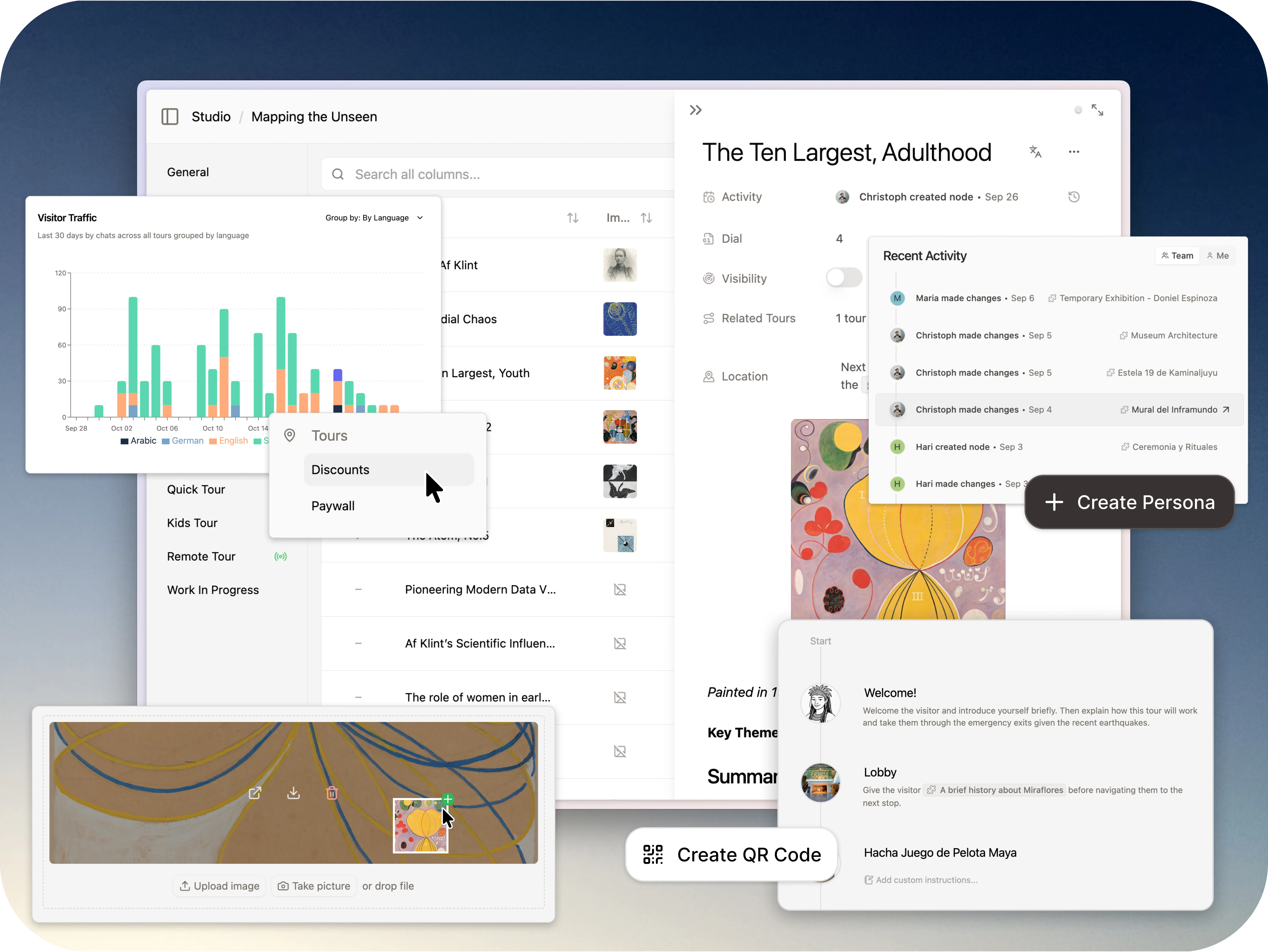
Musa Studio is the tour and content CMS. It allows you to create and update tours, items, and media in a single CMS. Publish in seconds so galleries and labels stay in sync.
Author once, reuse everywhere
Collect any information that might be relevant for visitors, then create tours that bring them alive. You can mix and match info from items to guides with multiple steps of customisation to make any tour feel unique.
Simple to use
Upload media and text, connect items to tours, publish. Shared patterns keep tasks consistent, like adding pictures or captions.
What you can do
- Author tours with steps, wayfinding, and media
- Connect items once and reuse across tours
- Run pre-publish checks and roll back instantly
Quality guardrails
Run evaluations before publishing so teams feel confident. Go live instantly or wait for evaluation approvals. Versioning keeps you aware of who changed what and instant rollbacks let you erase mistakes with ease.
Change speed
Updates are under museum control and can publish in seconds.
When Hari, the archaeologist at Miraflores, finished restoring an ancient Mayan sculpture that was added to the permanent exhibition, he uploaded the picture, added the description, and published it on the spot. Every guide was live with the change immediately.
8. Integrations and IT
Start with zero integrations
Musa is fully hosted and managed. No setup work required to begin.
Privacy and compliance
Analytics are aggregated and anonymous. No personal tracking of visitors.
Devices and access
Visitors bring their own device. One entry QR opens the tour chooser. On a tour, visitors search by object name or number. Works with cellular or museum Wi-Fi.
9. Analytics and Outcomes
What is measured
Usage over time, tour versus exploration balance, language mix, dwell and completion, top questions, content gaps, revenue where enabled.
How museums use the data
Refine exhibitions and copy, plan staffing, prioritize translations, and align programming with what visitors ask.
At Miraflores, one section of the tour takes visitors into a tomb where internet connectivity weakens. Analytics showed a sharp retention drop immediately after this section, with visitors appearing confused about whether the guide had stopped working. The team saw the data, identified the issue, and added a brief note from the guide just before entering the tomb: "Internet might be spotty in the next section, but I'll be right here with you." Retention after the tomb section recovered immediately, and visitors stayed engaged instead of abandoning the experience.
10. Implementation
Immediate start
You can create a tour today, print the QR, and use it with payments if desired.
Typical pattern
Two to four weeks of pilot, two to four weeks of iteration using analytics, then public launch. Timelines are flexible and set by the museum.
Roles and responsibilities
- Musa provides ingestion support, testing, and QR assets. We teach your team and stay available.
- The museum uploads assets, maintains the knowledge base, and leads curation with full control over voice and facts.
11. Operations and Support
Support hours
UK timezone. Weekdays during UK daytime we respond fast. Outside these hours we respond the next business day.
Targets
- P95 acknowledgement of new issues within 1 hour during UK daytime.
- P90 acknowledgement within 3 hours during UK daytime.
- Outside hours we acknowledge by 11:00 UK time next business day.
Severity handling
- Sev 1 outage or payment stop: immediate triage during UK daytime, status updates at sensible intervals until resolved.
- Sev 2 degraded feature: workaround or fix prioritised.
- Sev 3 minor bug or request: scheduled for the next suitable release.
Content cadence
You control cadence. Publish when ready. Musa product updates ship as needed and are announced ahead of impact.
12. Education Use
Teachers use Musa to plan visits, review content in advance, and gather reliable context before students arrive. Group features are upcoming.
A teacher in Guatemala City requested guide access the day before her school visit to Miraflores. She used it to plan the route spatially, deciding where her class would stop and how to keep students engaged without crowding. She coordinated with other teachers in her group to spread students across different sections at different times. "It made my life so much easier," she said. "With young students, they go all over the place if you're not watching them. This kept them engaged and gave me control over the flow of the visit."
13. Out of the Box Checklist
- Reliable Wi-Fi in target spaces or good cellular. Either is fine.
- One printed QR poster at entry and QR placements where tours begin.
- Tours and assets set up in Musa. Publishing checks ensure completeness.
- Short staff training so front of house can explain entry QR and tour choice.
14. Pricing
Choose how you want to offer access. Revenue Share funds itself as visitors pay. Subscription credits prepay access and let you charge through your own system or include access in the ticket. You can mix both at any time. Both models can generate revenue.
Revenue Share
No upfront costs. Free forever. Visitors pay through Musa. Revenue is shared automatically.
- Unlimited tours, nodes, and team members
- Integrated payments, discounts, analytics
- 40+ languages and 135+ currencies
- Start immediately and add credits later if you want
Subscription credits optional add on
Prepay visitor access with monthly credits. Use your own payments or include access in the ticket. Included credits are priced lower. Additional credits use the overage rate.
| Plan | Monthly price | Included credit rate | Included credits | Overage rate |
|---|---|---|---|---|
| Core | $100 | $2.50 per credit | 40 | $3.00 per credit |
| Growth | $1,000 | $2.00 per credit | 500 | $2.50 per credit |
| Scale | $10,000 | $1.50 per credit | ~6,600 | $2.00 per credit |
- Add credits at any time
- Credits can be used to comp visitors
- Works with ticketing or memberships
How to size credits
Credits are consumed on actual used tours. Sizing depends on take up rate, not total visitors. Typical range when not bundled is 3% to 7%. If you include access in the ticket, expect up to 20%.
Example: 100,000 annual visitors at a 7% take up rate need about 7,000 credits per year.
Why this model
We align incentives. You earn when visitors engage. We earn when the guide adds value. There are real per use AI costs, which is why prepaid credits have discounted rates and help us estimate data center capacity.
Notes: A credit equals one visitor access. Unused credits roll over for 30 days. Prices in USD. Local currency available.
15. Case Study
Venue
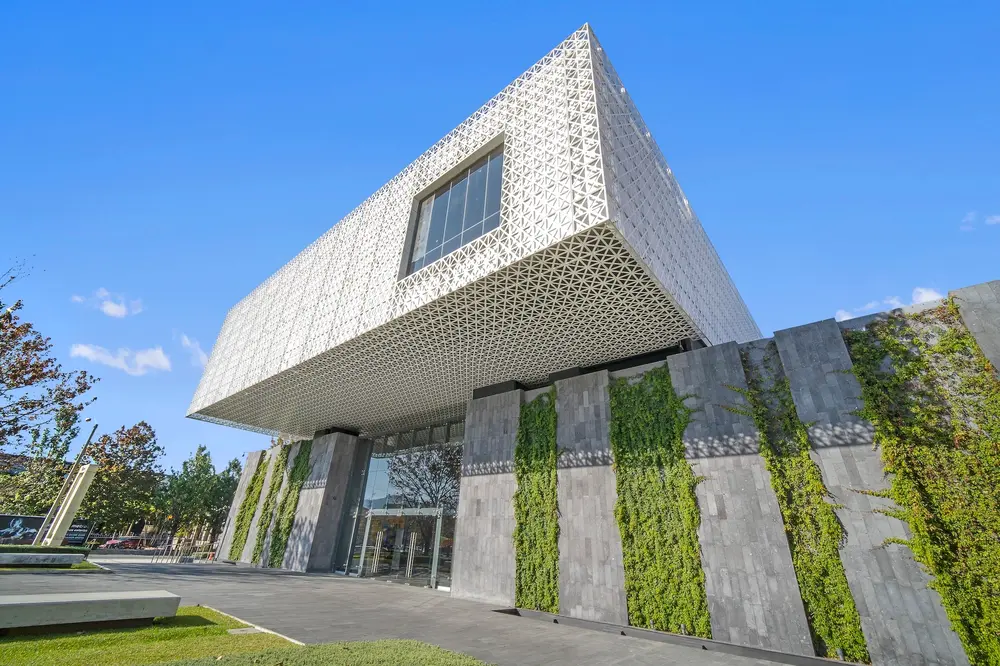
Museo Miraflores, Guatemala City.
Headline result
Roughly five times higher uptake than prior devices. Average sessions exceed thirty minutes, with some near two hours.
What changed
After years of working with traditional audio guide implementations, Maria Gadsden, Director of Miraflores, approached Musa with cautious optimism. "After my previous experience with implementing an audio guide, I had obviously heard promises of 'easy implementation' before," she recalls. "But once we actually went through it with Musa, I was stunned at how straightforward the process truly was."
The quality matched the ease. "I love letting visitors explore any question they've ever had and really dive into Mayan culture in a way that resonates with them," Gadsden says. The onboarding impressed her most—Musa's team was consistently available, supportive through every issue, and made the entire process feel collaborative rather than transactional. For a museum that had struggled with the rigidity and costs of legacy systems, the ability to update content instantly and respond to visitor curiosity transformed how the team thought about visitor engagement.
Read the full Miraflores case study →
16. Next Steps
Book a demo
Email hi@musa.guide or visit musa.guide/contact.
What to prepare
Nothing. Just join the demo and we will show you how it works.
If you want to tailor the session, feel free to bring:
- A couple of items or stories from your collection you care about
- What you want visitors to get out of the experience
- Any practical constraints or hopes for a pilot